Category

Education

Category

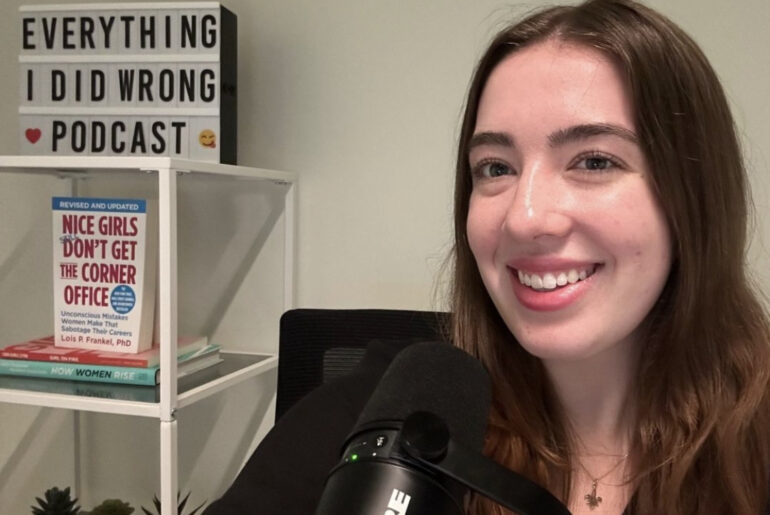
Episode 105: Ripple Effects Artists

What if art wasn’t just something we experienced but something that moved us to act? This week’s Charity Matters episode introduces you to Jessie Fahay, a true “Ripple Effects Artist” who is transforming the way we think about theater, storytelling, and service. Jessie doesn’t just create powerful productions ….she creates experiences that spark conversations, challenge perspectives, and connect audiences directly to the people and causes working to change our world. Her work sits at the intersection of art and advocacy, reminding us that when we feel something deeply, we have a responsibility to do something with it.

Jessie’s journey is a beautiful example of what happens when passion meets purpose. From performing in meaningful productions like The Diary of Anne Frank to asking herself the life-changing question, “What is my life actually for?” She found a way to use her gifts to elevate others. In this inspiring conversation, Jessie shares how one idea turned into a 15-year movement, the lessons she’s learned along the way, and why even one small ripple of action can create lasting impact. This episode will leave you thinking differently about the power of creativity and your own ability to make a difference.


Here are a few highlights from our conversation:
Charity Matters: Tell us a little about what Ripple Effects ARTISTS does?

Jessie Fahay: We are predominantly a theatrical production company, but what makes us unique is that everything we produce is rooted in purpose. We create theater and sometimes film or radio plays, that raise both awareness and funds for human rights organizations and advocates.

After every production, we host talkback conversations which are panels that feature leaders whose work directly connects to the themes of the show. So it’s not just about experiencing art and walking away. It’s about engaging, asking questions, and creating a space where audiences can connect what they’ve just seen to real-world action.

Charity Matters: What experiences did you have as a child that influenced your work?

Jessie Fahay: There wasn’t just one moment….it was really a collection of experiences that shaped me.

One of the most impactful was touring as an actor with The Diary of Anne Frank. It was an educational production for students, and after every show we would have these deep, thoughtful conversations about prejudice, bigotry, and history. I saw firsthand how powerful theater could be not just as entertainment, but as a catalyst for dialogue and understanding.

Then there were experiences in high school, like when Columbine happened. We did a production called Bang Bang You’re Dead, which explored the root causes behind school violence. That was another moment where theater wasn’t just art but it was a way to process, question, and try to understand the world.

And living in New York, I’ve had the privilege of seeing incredible theater. Shows like The Normal Heart left me emotionally undone…..but more than that, they left me wanting more. I didn’t want the experience to end when I walked out of the theater. I wanted to keep talking, keep unpacking, and ask, “What now?” That feeling stayed with me.

Charity Matters: What was the moment you knew you needed to act and start Ripple Effects ARTISTS?

Jessie Fahay: It really came down to a question someone asked me: What is your life actually for? That question changed everything. It shifted me from thinking about what I wanted to do to thinking about what I was here to contribute.

I realized I understood powerful theater. I knew what meaningful storytelling looked like, and I also knew there were incredible nonprofit organizations doing important work that needed a platform. And it just clicked. I could bring those two worlds together.

All of my past experiences funneled into that moment. It wasn’t just one play or one experience, it was everything combined. But that question gave me clarity. It gave me direction. It made me see that this wasn’t just a career idea it was my contribution.

Charity Matters: What are your biggest challenges?

Jessie Fahay: In the beginning, the biggest challenges were simply figuring everything out. The logistics, the paperwork, how to even become a nonprofit….it’s a lot. We didn’t officially incorporate until 2013, even though we started in 2009. And beyond that, you have to be okay wearing a lot of hats. You’re an entrepreneur, a producer, a fundraiser, a marketer…..you’re everything.

You’re constantly pitching, not just a product, but a mission. You’re asking people to give their time, their money, their energy. You’re building something that depends on other people believing in it. And that’s both the challenge and the beauty of it. You’re constantly connecting people to something bigger than themselves. But it takes resilience, and it takes a willingness to keep going even when it’s hard.

Charity Matters: What fuels you to keep doing this work?

Jessie Fahay: It’s the moments when I see the model actually work. When we have a talkback after a show and the audience is engaged and when you can feel that something has landed, that something has sparked…..that’s everything.

It might be a small theater, it might be a modest audience, but when people get it, when they connect the dots, there’s nothing better than that. It’s similar to what teachers describe when a student finally understands something. That moment of clarity, that moment of connection….that’s what fuels me.

Charity Matters: When do you know you have made a difference?

Jessie Fahay: We’ve actually looked at some data, and about 5% of our audience takes immediate action during the show…..signing petitions, committing to volunteer, or deciding to donate. But beyond the numbers, it’s those connections that matter.

It’s when someone discovers an organization they’ve never heard of even though it’s right in their own city and decides to get involved. It’s when people from completely different worlds come together and realize they care about the same issue.

That’s when I know we’re making a difference…….when awareness turns into action, even in small ways.

Charity Matters: Tell us what success you have had and what your impact has been? 

Jessie Fahay: We’ve been doing this for over 15 years, and we’re heading into our 17th season. That alone is something I’m incredibly proud of. We’ve created a model where art and advocacy work together…..where theater becomes a platform for real-world impact.

We’ve helped bring visibility to organizations that people didn’t even know existed. We created spaces where audiences don’t just consume art, but engage with it and act on it. And while the numbers matter……the attendance, the funds raised, the actions taken…..it’s really about those moments of connection. Those are the true measure of success for me.


Charity Matters: If you could dream any dream for your organization, what would that be?

Jessie Fahay:  I would love to see Ripple Effect Artists on a Broadway stage…..creating work that is not only artistically excellent, but also deeply impactful. But beyond that, the bigger dream is that this model becomes something widely adopted—that the arts and advocacy become more deeply connected across all disciplines.

There is so much powerful art being created, and there is so much important advocacy work happening. Bringing those two together creates something even more meaningful. I truly believe that can elevate both the credibility of the arts and the reach of advocacy. That’s the vision.

Charity Matters: What life lessons have you learned from this experience?

Jessie Fahay: One of the biggest lessons is that this work isn’t for everyone…..and that’s okay. Not everyone wants to engage with heavy, thought-provoking theater. Not everyone wants to be involved in this kind of work. And I’ve learned not to try to convert people.

If I could go back and tell myself anything, it would be: don’t spend so much energy trying to make people fit. Let them find their own path, and focus on finding the people who align with yours. That shift would have saved me a lot of time and energy.

Charity Matters: How has this journey changed you?

Jessie Fahay: This journey has required me to grow in ways I didn’t expect. I’ve had to learn how to embody different energies…..to be compassionate and open-hearted, but also strong, clear, and sometimes firm.

Running a nonprofit means making tough decisions, setting boundaries, and leading with clarity. You can have a big heart and still be a strong leader. And I’ve also learned to meet people where they are and to accept what they can give, without expectation or judgment.

At the end of the day, this work has made me more resilient, more grounded, and more committed to the idea that we all have something to contribute. And when we find what that is, and give it away, that’s when real change happens.

CHARITY MATTERS.


YOUR REFERRAL IS THE GREATEST COMPLIMENT,  IF YOU ARE SO MOVED OR INSPIRED, WE WOULD LOVE YOU TO SHARE AND INSPIRE ANOTHER. If you enjoyed today’s episode, please connect with us:

Copyright © 2026 Charity Matters. This article may not be reproduced without explicit written permission; if you are not reading this in your newsreader, the site you are viewing is illegally infringing our copyright. We would be grateful if you contact us.
Episode 103: Walk with Me Brother

Some stories ask you to listen. Others ask you to feel. And then there are the rare ones, like this one, that ask you to walk alongside them. This week on the Charity Matters Podcast, you’ll meet Robb Pollard, a husband, father, entrepreneur, and now the founder of Walk With Me Brother, who is about to do something extraordinary. On Monday, Robb began a 2,500-mile run across America…..not because he’s a runner, not because it’s easy, but because he knows what it feels like to be at the very bottom and wonders if his journey might help someone else choose to stay. This isn’t about miles. It’s about meaning. It’s about one man’s decision to turn pain into purpose and to remind us all that asking for help might be the bravest step we ever take.

By the time this episode airs on Thursday, Robb will already be on the road one step at a time, inviting all of us to come with him. His story is raw, honest, and deeply human. It’s about mental health, about breaking the silence so many men carry, and about the power of simply showing up for one another. If you’ve ever wondered how one person can make a difference, this conversation will stay with you. Because sometimes, changing the world doesn’t start with a grand plan …it starts with one step… and the courage to take it.


Here are a few highlights from our conversation:

Charity Matters: Tell us a little about what Walk With Me Brother does?

Robb Pollard:  Walk With Me Brother is a mental health nonprofit, but I try not to overcomplicate it. At its core, it started with one simple goal: help one person. If I could save one person from taking their own life (most likely a man) then everything I’m doing is worth it.

That’s really it. That’s the mission.

People talk a lot about mental health awareness, but the truth is, we’re already aware. We know what mental health is. What we’re trying to do is take action…real action to prevent suicide. For me, that means creating connection. It means building a brotherhood where people feel safe enough to talk, to open up, to not feel alone.

The run across America is part of that. It’s a way to get attention without destroying myself. It’s a way to show people, especially men, that there is another option. That you can ask for help. That you can choose a different path.

If I have to run 2,500 miles to reach one person, then it’s worth every step.

Charity Matters: What experiences did you have as a child that influenced your work?

Robb Pollard:   I grew up in a small town in England, and it was very community-driven. Everyone knew each other. Neighbors looked out for one another. It wasn’t nonprofit work in the formal sense, but it was people helping people.My grandmother, my Nan, had a big influence on me. She always used to say, “No matter what you’re going through, there’s always someone worse off than you.” That stuck with me. It gave me perspective early on.

As I got older, I naturally gravitated toward helping where I could. When I lived in Shanghai, I worked with an animal rescue and ended up fostering over 100 dogs. I also spent time with an orphanage, which was pretty eye-opening.

But even then, I never thought I’d start a nonprofit. I just thought I’d support causes, donate money, do my bit. Looking back now, all those experiences were shaping me. They were laying the groundwork for something bigger….I just didn’t know it at the time.

Charity Matters: What was the moment you knew you needed to act and start Walk With Me Brother?

Robb Pollard: The moment everything changed was when I said three words: I need help.I couldn’t even say it out loud at first. I had to write it in an email to my family. But that was the turning point. I knew that nothing was going to change unless I did something different.

I’d been struggling for a long time with my mental health, with addiction, with feeling like I was never enough. And even when I got sober, there was still that voice in my head. I knew eventually I’d crack if I didn’t do something drastic.

Then I went through ketamine infusion therapy, and during one of the sessions, I had this vision of myself running across America. It wasn’t about ego. It wasn’t about proving anything to anyone else. It was about doing something so big that people would notice and in noticing, maybe they’d realize there’s another way. That idea stuck with me. I couldn’t ignore it.

And once it was there, I knew I had to follow through. That’s when it shifted from just a personal challenge to something bigger….a mission. That’s when Walk With Me Brother really began.

Charity Matters: What are your biggest challenges?

Robb Pollard: I definitely underestimated how hard this would be. Starting a nonprofit is no joke. There’s no clear roadmap, and everything takes more time, more effort, and more consistency than you think. Fundraising alone is a massive challenge we’re trying to raise around $80,000 just to support the run.

Then there’s building the right team. The people around you have to believe in the mission. A lot of the people helping right now have personal stories of loss, struggles, experiences with mental health and that’s what drives them. On a personal level, the biggest challenge is balancing everything. I have a business, a wife, kids, a life. And I’m about to step away from that for a long time to do something that’s physically and mentally demanding.

There are moments where I think, “What am I doing?” But once you commit to something like this, there’s no backing out. You just have to keep going.

Charity Matters: What fuels you to keep doing this work?

Robb Pollard: What keeps me going is the thought that someone might still be here because of this. Maybe a kid still has his dad. Maybe a parent still has their son. That’s what I hold onto.

And then there’s my own family. My kids might not understand this right now, but one day they will. I want them to see that you can push yourself beyond what you think is possible. That you can do hard things.

There’s also something personal in this for me. I’ve never really felt proud of myself. This is about changing that. It’s about proving to myself more than anyone that I can do something meaningful.

Charity Matters: When do you know you have made a difference?

Robb Pollard:  If one person chooses to stay because of this, then I’ve made a difference.

That’s success to me. It’s not about numbers, followers, or how much money we raise. It’s about impact. One life is enough.

Charity Matters: Tell us what success you have had and what your impact has been? 

Robb Pollard:  We’re still early in the journey, but already I’m seeing the impact. People are reaching out. They’re sharing their stories. They’re opening up in ways they haven’t before. That alone tells me this is needed.

The real impact will come over time. We’re building something bigger than just the run it is a community, a brotherhood, a place where people can talk without judgment. We’re also working on future initiatives things like providing access to support for people who can’t afford it, creating local walking communities, and bringing in ideas that have worked in other countries.

This isn’t a one-time event. This is the start of something much bigger.

Charity Matters: If you could dream any dream for your organization, what would that be?

Robb Pollard: The dream is to create a system where no one feels like they have nowhere to turn. I want Walk With Me Brother to become a community….something people can plug into anywhere. Walks, conversations, meetups. Real connection.

I’d love to see it grow across the country and beyond. I want to go into schools, especially high schools, and talk to young men. If we can reach them early and show them it’s okay to ask for help, we can change outcomes.

Long term, I’d like to create access to real support whether that’s therapy, resources, or just someone to talk to. Something practical, not just awareness.

Charity Matters: What life lessons have you learned from this experience?

Robb Pollard: The biggest lesson is that asking for help isn’t weakness it’s strength. There is always someone out there who will help you. You just have to ask.

I’ve also learned that nothing changes unless you change something. You can’t stay stuck and expect things to get better. And I’ve learned how important it is to have the right people around you. This isn’t something you do alone. The people involved in this all have a connection to the mission. That matters.

Charity Matters: How has this journey changed you?

Robb Pollard: It’s already changing me, and I know the biggest changes are still to come.

I’m someone who’s always been very family-oriented, very comfortable at home. This is pushing me way outside of that. Being away from my family is going to be one of the hardest parts. Physically, it’s going to be tough. But mentally, it’s going to be even tougher.

At the same time, I know that if I can do this, I’ll come out stronger. I’ll know what I’m capable of. And more than anything, I’ll know that I tried to make a difference. Even if it’s just for one person.

Because at the end of the day, that’s all this has ever been about.

CHARITY MATTERS.


YOUR REFERRAL IS THE GREATEST COMPLIMENT,  IF YOU ARE SO MOVED OR INSPIRED, WE WOULD LOVE YOU TO SHARE AND INSPIRE ANOTHER. If you enjoyed today’s episode, please connect with us:

Copyright © 2026 Charity Matters. This article may not be reproduced without explicit written permission; if you are not reading this in your newsreader, the site you are viewing is illegally infringing our copyright. We would be grateful if you contact us.
Episode 102: JDS Creative

We often think of the arts as something extra….something creative, expressive, maybe even optional. But what if the arts were actually the bridge to confidence, communication, independence, and purpose? In this powerful and inspiring conversation, I sit down with husband and wife Diane and Scott Strand, the founders of JDS Creative Academy, who are using the arts in the most extraordinary way…..to transform lives. What began as two creatives working in Hollywood, juggling long hours and raising a young family, turned into a simple “what if?” and that one question has now grown into a thriving nonprofit that is changing the trajectory of lives every single day.

Through filmmaking, acting, digital media, and storytelling, Diane and Scott are giving people, especially adults with developmental disabilities, the tools to find their voice, build real-world skills, and step into a life they may have never believed possible. This episode is a beautiful reminder that sometimes the greatest impact doesn’t come from grand plans, but from saying yes to one person, one opportunity, one moment at a time. Their story is filled with heart, humility, and hope and it will leave you inspired to look at your own gifts and ask, “What if I used them to help someone else?”


Here are a few highlights from our conversation:


Charity Matters: Tell us a little about what JDS Creative does?

Diane Strand:  JDS Creative Academy is a nonprofit 501 c3 with a mission of using visual, performing, and digital arts to enhance life, creativity, and business. We serve youth, teens, and adults both mainstream and special needs through hands-on programs that allow people to step in and immediately be part of the creative process.

The goal is not just learning the arts for fun, although there is joy in that. It is about giving people tools they can use for career pathways, workforce development, and independence. We want people to understand the power of the arts….not just as expression, but as a way to build a life.

Charity Matters: What experiences did you have as a child that influenced your work?

Diane Strand:  I always say you cannot connect your dots looking forward you have to look back. For me, those dots go all the way back to first and second grade. I was a little girl who just wanted to play Betsy Ross in the school play, and everyone told me I couldn’t. I was a struggling reader, an undiagnosed dyslexic, and school was not easy for me.

But the arts were my connection. They kept me engaged in learning and gave me a way to grow beyond my challenges. At the time, I couldn’t articulate why it mattered so much, but now I see it clearly. The arts gave me a voice when I didn’t have one in other areas.

Later in life, when Scott and I were in Hollywood and becoming successful, the environment wasn’t always kind. Something in me instinctively knew I wanted something different something rooted in kindness and purpose. Looking back, all of those experiences were pointing me here.


Charity Matters: What was the moment you knew you needed to act and start JDS Creative?

Scott Strand:  It really started with a “what if” moment. Diane and I were both working long, exhausting hours, and we had just had our son. I was taking him to auditions in a stroller, and Diane was leaving before he woke up and coming home after he was asleep. It just wasn’t sustainable.

One night, after I finished my film degree, I said, “What if we sold everything, moved, and built our own production company? You know how to produce, I know how to film….we can do this.” She said yes, and that started our entrepreneurial journey.

The nonprofit came later, and it happened organically. We had a successful production company and an actor studio that grew out of a drama club we were running. People kept asking us to do more teach writing, filmmaking, theater. We kept saying yes.

Then one day someone asked, “What if you worked with an adult with developmental disabilities who wanted to learn audio?” We said, “Let’s try it.” And once we saw what was possible, it became, “If we can teach one, we can teach many.”

That was the moment. It wasn’t a grand plan……it was a series of “what ifs” that we chose to answer.

Charity Matters: What are your biggest challenges?

Scott Strand: One of the biggest challenges is capacity. The need is so much bigger than what we can serve. When we started, we had five adults in the program, and very quickly that number grew. Once people saw what we were doing, the applications started coming in.

It’s a good problem, but it’s also a hard realization that you cannot meet every need. No matter how much you want to help, you can only serve as many people as your resources allow.

Another challenge is building the right team. Not everyone understands the nonprofit space or shares the same vision right away. We had to grow into leadership that allows people to be creative while still supporting the mission. Now we have a team that truly believes in what we are doing, and that makes all the difference.

Charity Matters: What fuels you to keep doing this work?

Diane Strand:  For me, it’s the people. It’s our students, our families, and our team. Some of the people who stepped in during the early years are still here today. That kind of loyalty and belief is incredibly powerful.

Our own children fuel us as well. They grew up in this environment…. in the arts, in the theater, in this mission and they’ve bought into it completely. That tells me we’re building something that matters.

And truly, the more you serve, the more you receive. That has been one of the greatest lessons of this journey. You give and give, and somehow your life becomes fuller in the process.


Charity Matters: When do you know you have made a difference?

Scott Strand:  It’s in the small, real moments. It’s when you see the light bulb go on. I had a moment recently where I walked into the studio and saw a group of students some neurotypical, some adults with autism sharing their ideas for films they wanted to create.

They were listening to each other, supporting each other, and fully engaged. I stopped and thought, “This is it. This is why we do this.”

It’s not about numbers it’s about those moments where someone feels seen, heard, and capable.

Charity Matters: Tell us what success you have had and what your impact has been? 

Diane Strand:  Of course, we’ve had awards and recognition, and those are wonderful. But our real success is in the lives we’ve seen transformed.

We’ve had students who didn’t speak much at home start coming home and sharing their day with their families. We’ve had individuals placed into internships and jobs. We’ve seen people gain independence and confidence in ways they never thought possible.

I always say, “Help one person every day,” because that one act creates a ripple effect. When someone grows here, they take that growth home, into their families, into their communities. It changes everything.


Charity Matters: If you could dream any dream for your organization, what would that be?

Diane Strand:   We created JDS Creative Academy to outlive us. The dream is legacy. We want this work to continue far beyond our time.

I would love to see programs like this across the country arts-based workforce development programs that help adults with developmental disabilities build real skills, find independence, and thrive.

We are working toward making the organization self-sustaining so it can continue without relying on us. That’s the dream that what we’ve built lives on and continues to serve.

Charity Matters: What life lessons have you learned from this experience?

Diane Strand:  Patience has been one of the biggest lessons. I came from a fast-paced, results-driven world, and this work requires a different kind of leadership one rooted in patience, kindness, and compassion.

It has also taught me to be more open. For most of my life, I worked around my dyslexia and didn’t talk about it. Now I can share that part of my story and recognize that it’s not something to hide, it’s part of what shaped me.

Kindness, clarity, and perspective those are the lessons I carry with me every day.

Charity Matters: How has this journey changed you?

Scott Strand: It’s allowed me to become more myself. I’ve always been a performer at heart, but for a long time I felt like I had to be more guarded as a business owner and leader.

Now I can lead with humor, creativity, and openness. I can be playful, and that actually makes me a better leader. It creates an environment where people feel safe to express themselves and grow.

This journey has shown me that when you help someone step into who they truly are, it doesn’t just change their life it changes yours too.

CHARITY MATTERS.


YOUR REFERRAL IS THE GREATEST COMPLIMENT,  IF YOU ARE SO MOVED OR INSPIRED, WE WOULD LOVE YOU TO SHARE AND INSPIRE ANOTHER. If you enjoyed today’s episode, please connect with us:

Copyright © 2026 Charity Matters. This article may not be reproduced without explicit written permission; if you are not reading this in your newsreader, the site you are viewing is illegally infringing our copyright. We would be grateful if you contact us.
World Health Day: Caring for ourselves, Caring for our world

Each year on April 7th, the world pauses to recognize World Health Organization’s World Health Day, a global reminder that our health is our most precious resource. Established in 1950 to commemorate the founding of the World Health Organization, the day highlights critical health issues affecting people around the globe and encourages governments, communities, and individuals to take action toward healthier lives.

But while the name may sound global and grand, the truth is that world health actually begins in very small, very personal places: in our homes, in our neighborhoods, and in the choices we make every single day.

Health is something we often take for granted….until we don’t have it. Whether it’s a sudden diagnosis, an injury that slows us down ( yep)  or watching someone we love struggle with illness, those moments remind us how fragile and precious our well-being truly is. Our health is the foundation that allows us to show up for the people we love, pursue our dreams, and serve others in meaningful ways.

Without our health, everything becomes harder….trust me something I am very aware of these days.

The purpose of World Health Day is not simply to recognize doctors, hospitals, or health organizations….although they certainly deserve our gratitude. It is a call for all of us to take responsibility for our own well-being and for the well-being of our communities. Because health is not just about medicine. It is about lifestyle, environment, connection, and care.

Healthy communities create a healthier world.

When we take care of ourselves we are better equipped to help others. A parent who prioritizes their health can be present for their children. A teacher who protects their well-being can inspire generations of students. A volunteer who feels strong and energized can serve their community with compassion and purpose.

Health creates capacity. In many ways, caring for ourselves is one of the most important acts of service we can offer the world.

Around the globe, access to healthcare, clean water, nutritious food, and safe living conditions remains a challenge for millions of people. These disparities remind us that health is not simply a personal issue but it is a collective one. When communities work together to improve health resources, advocate for better systems, and support those in need, we move closer to a world where everyone has the opportunity to live a healthy life.

But change does not always require sweeping global initiatives. Sometimes it begins with simple acts within our own neighborhoods.

Check in on an elderly neighbor who may be isolated.
Bring a healthy meal to a friend recovering from surgery.
Support a local health clinic or nonprofit that serves vulnerable families.
Encourage children to play outside and stay active.
Take a walk with a friend instead of meeting over coffee.

These small actions ripple outward in ways we may never fully see.

Health is also deeply connected to kindness and connection. Loneliness and isolation are now recognized as serious public health concerns. When we reach out to others, build community, and foster meaningful relationships, we strengthen not only emotional well-being but physical health as well.

In other words, caring for each other is a form of healthcare.

The past few years have reminded the world just how interconnected our health truly is. A virus that began in one corner of the world quickly affected every community on the planet. We learned that protecting one another through science, cooperation, and compassion was essential to protecting ourselves.

Global health begins locally.

When we make choices that strengthen our own well-being getting enough sleep, moving our bodies, nourishing ourselves with healthy food, managing stress, and nurturing relationships…..we are contributing to a healthier society. When communities prioritize parks, clean air, safe neighborhoods, and accessible healthcare, they build the foundation for future generations to thrive.

And when we look after the most vulnerable among us, we honor the idea that everyone deserves the opportunity to live a healthy life.

This World Health Day, perhaps the best thing we can do is pause and ask a simple question:

What is one small step I can take today to care for my health and the health of my community?

Maybe it is scheduling that doctor’s appointment you’ve been putting off.
Or choosing to move your body and enjoy the outdoors.
Maybe it is checking in on someone who may need encouragement or support.

Health is not built in a single day. It is built through daily choices, shared responsibility, and the understanding that we are all connected.

When we take care of ourselves, we strengthen our families.
And when we strengthen our families, we build healthier communities.
When communities thrive, the world becomes a healthier place for us all.

Because in the end, a healthier world begins with each of us. 🌎

CHARITY MATTERS.


YOUR REFERRAL IS THE GREATEST COMPLIMENT,  IF YOU ARE SO MOVED OR INSPIRED, WE WOULD LOVE YOU TO SHARE AND INSPIRE ANOTHER. If you enjoyed today’s episode, please connect with us:

Copyright © 2026 Charity Matters. This article may not be reproduced without explicit written permission; if you are not reading this in your newsreader, the site you are viewing is illegally infringing our copyright. We would be grateful if you contact us.
Episode 97: For Farmers Movement

Before Dana DiPrima ever set out to start a movement, she was busy connecting people and communities in every corner of her life…..government, nonprofits, corporations, and even as a soccer mom “on steroids” serving 4,200 kids. What she didn’t know then was that a simple “yes” to backyard chickens would quietly change everything. That accidental farm in the Catskills introduced her to farmers whose work is nothing short of miraculous, yet largely invisible. As Dana began listening to their stories, their struggles, their pride, and their resilience…..she realized that the people feeding us every day were not being valued. Farmers weren’t asking for charity; they wanted to be seen, valued, and supported. And once Dana sees a problem that matters, she doesn’t look away.What followed was the birth of the For Farmers Movement, a bold, grassroots effort built on small actions with big impact. Since 2022, Dana has helped distribute hundreds of grants to farmers across nearly every state, proving that even $1, when multiplied by community, can change lives. Fueled by persistence, heart, and a deep belief that good grows when people are given simple ways to act, Dana has created more than a nonprofit….she’s built a movement rooted in honor, connection, and hope. Her story will forever change the way you think about the food on your table and the people who make it possible.


Here are a few highlights from our conversation:

Charity Matters: Tell us a little about what For Farmers Movement does?

Dana DiPrima:  Since 2022, we have given grants to farmers across the country in 48 states and one territory and that’s just a small piece of what the For Farmers Movement does. It really started because I felt like we go about our busy lives and we don’t think about the people who are doing things that are essential to our society. We just take them for granted. I sort of crept into the farmer space accidentally through a little accidental farm that I have. That introduced me to these local farmers who were the most amazing people.  I started listening to what they were saying and what they were doing.

 I started the For Farmers Movement because I feel like we need to focus on the people who are essential like this. Farmers are providing us with delicious and healthy food for our families, and they’re knitting together our communities. A lot of our grants are farmer-to-farmer by supporting projects where they’re buying locally, working locally, strengthening their own towns. Every single small farm is a local economic driver. Wouldn’t you rather have one giant farm driving an economy, or 200 small farms doing it? We do grants, but we do a lot of other things too. It’s all about helping people see farmers, value them, and support them in real, practical ways.

Charity Matters: What experiences did you have as a child that Influenced this work?

Dana DiPrima:   I think it’s always been a little bit a part of my DNA. I’m not 100% sure where it came from, except that in my first years out of college and in every job I’ve had every career I’ve had has always been about connecting the dots between people and communities. I’ve worked in government, nonprofits, corporations, and community-based organizations, and the thread through all of it has been moving the needle for good. Even when you’re making small improvements, it’s still an improvement, and I think it’s important to know that in your life the little things that you do that are good, they add up.

Even when I worked in a big corporation with all the media moguls, I was the good girl. I was the head of cause-related marketing.  Where I could show clients how to have a heart and a soul in their work.  It’s been a long and interesting ride, but I think I bring everything to bear here in the For Farmers Movement. Everything I’ve experienced, all of the charities I’ve worked with, all of the innovative ideas, and all of the questions led to this.

I learned a lot from incredible experiences. With St. Jude Thanks and Giving, the one thing I learned from Marlo Thomas is never say die. She does not take no for an answer. And when I worked at Jones Apparel Group, I was so proud that we focused on smaller nonprofits, making a real difference with AdoptAClassroom, teacher fund, and campaigns like Behind Every Famous Person is a Fabulous Teacher. You have to get people’s attention in 100 different ways. You have to be tenacious. You have to never quit. And all of that, it all adds up. It all leads to this.

Charity Matters: What was the moment you knew you needed to act and start For Farmers Movement?

Dana DiPrima: If you look at it from the 35,000-foot view, it might not make any sense at all. Before starting the For Farmers Movement, I was the commissioner for 10 years for the largest youth soccer league in the country.  More like, I was a soccer mom on steroids, with 4,200 kids. It was a community of people who needed support and direction. Around that same time, I had a property in the western Catskills and also lived in New York City, which is a pretty dramatic contrast. I had little kids, and when my daughter asked, “Can we get some chickens?” I said yes without blinking. Then one escaped, I panicked, called the farmer, and he said, “Find your inner predator,” and hung up on me. I hunted down that chicken with big leather fireplace gloves on, caught it, and I never looked back.

From there, things escalated. Chickens turned into goats, then donkeys, ducks, bees, and 17 gardens that I do myself. I just sort of went off the deep end. But through all of that, I started to understand farmers in a real way. They became friends, touchstones, people I learned from. In 2019, I started a podcast called Talk Farm to Me. I was just a microphone and I wanted farmers to tell their stories because they’re amazing.

What they do to get butter to your table is nothing short of miraculous. Your hamburger took two to three years to get to the plate, daily work for that one meal. Then the pandemic hit, farmers were suddenly considered essential, there was this huge spotlight moment, and then overnight it disappeared. I kept listening. In 2022, after hearing a woman speak about community at a conference, everything connected. I went home, wrote a 40-page manifesto, called my coach, and said, “I have to make a presentation to you, and you have to tell me if I’m nuts.”

That led to what I call the six-grand experiment. I started on Instagram and said, “You’ve got to find your local farmers. Tag them to nominate them for a grant.” It was a mess….hundreds of nominations, reaching out to farmers who had never heard of me but we awarded six grants across the country, and it was proof. Farmers can stretch a dollar like nobody’s business. There’s not one farmer who doesn’t have a project on the back burner that could help them get to the next level. The biggest aha for me was realizing that farmers are invisible. We don’t know where our food comes from, and farmers are incredibly proud. They don’t have their hands out for charity. This is not charity. It’s an opportunity to invest in your farmer and your community. That nomination is a permission giver, but it’s also honor. And even if nothing comes from it beyond that moment of being seen, that matters.

Charity Matters: What are your biggest challenges?

Dana DiPrima: The hardest things are like a daisy chain of hardest things. The end of 2025 is the first year I don’t feel like I’m carrying it all on my back. I feel like it’s moving on its own now. There are a lot of people invested in the, For Farmers Movement. Farmers supporters, and people across the country who care about their health, their communities, their economy, and their environment. But people are busy, and they care about a lot of things, so part of my work is helping them understand why they need to care about small farmers. That’s why it’s so important to me to give people small actions that have a big impact. We are built on that.

I’ve given away almost $200,000 in grants since 2022. Every year on January 1 the ticker starts again.  I’ve got to raise more money. But the spirit of this is that $1 from a million people is more valuable than a million dollars from one person, which I would accept, of course. Because when I give a farmer a $1,000 grant and tell them there are 1,000 people standing in their field, recognizing them, applauding them, cheering them on, that is more meaningful than a big corporate check.

Charity Matters: What fuels you to keep doing this work?

Dana DiPrima: On the one side, I get a farmer calling me crying on the phone because she’s so excited. A 10th year farmer that she just got a grant to move her farm. And she can’t believe the community behind her. I can’t tell you how meaningful that is.

And on the other side, I have farmers in my inbox: “I’m so disappointed we didn’t get a grant.” And someone sends me a farm with a huge fire. So what can I do? We have an emergency fund. We have wish lists. We have 97 farmers and growing on the wish list. It’s really easy to click send…work gloves, socks. My daughter sent socks to a farmer and got the delivery message.

So again: go to the wish lists. Find a farmer in your state. Click send.

Charity Matters: When do you know you have made a difference?

Dana DiPrima: Every single farmer I’ve supported with a grant has said it’s about way more than the money. The impact is them being seen, being recognized. That nomination is honor. Farmers are invisible every day. And for someone to honor the work that matters.

Charity Matters: Tell us what success you have had and what your impact has been? 

Dana DiPrima: I count numbers….291 grants, 48 states and one territory. People’s Choice Award: 45 farmers submit videos and we get over 20,000 votes. 97 farmers on the wish list.

But more important than any of that is being seen. And I share facts too: less than 2% of our population are farmers feeding 100% of us. We lost 141,271 farmers between 2017 and 2022 and that’s over 20 million acres we can’t get back. If you shop in your supermarket, 15% stays local, but if you shop at the farmers market, over 70% stays in your local community. I try to build awareness of how important your support is.

Charity Matters: If you could dream any dream for your organization, what would that be?

Dana DiPrima: I’m living a lot of it. Every year we’re doing something different and bigger. We went from that six-grand experiment to 100 grants a year.

In 2026 we selected 20 farms for a $10,000 farm-changing grant. We’ll make that award during National Ag Week in mid-March.

And I want to keep bringing customers closer. Nominate your farmer all year. In February we send postcards, kits of 10 stamped postcards. People tell me how much it meant to say thank you. We have the Voice Awards. We piloted Walk a mile in a farmer’s boots and we’re expanding to 10 markets. And anytime you can shop the wish list. Always opportunities to do something good for farmers.

Charity Matters: What life lessons have you learned from this experience?

Dana DiPrima: Starting a movement is a crazy idea, and it’s really, really hard, and I quit. Tuesdays and Thursdays I basically quit. And I didn’t quit. I didn’t take no for an answer. That failed? I’m trying this.

I’m always trying to give people opportunities to do something good that isn’t painful. Five minutes, forty minutes, $10,000 or $1. The strongest things are the simplest. Everyone can do $1. I’m going to get to a million dollars, $1 at a time. Vote for your farmers. You don’t even have to know them.

Charity Matters: How has this journey changed you?

Dana DiPrima: Oh, I can pick up a chicken. I’m a veterinarian, a zookeeper, an excellent housekeeper and bucket scrubber. But I think I’m very much the same. I love to work, like to figure it out, like the challenges, talking to people and I like to hear why you don’t believe it yet so I can think about what I haven’t done.

The success is built on the small actions. My newsletter every Tuesday, 52 weeks a year. My podcast has gone two full years of not missing a Thursday. And I also have a life….dinner for nine, making my table nice, getting the Christmas tree up.

That is life. That is living. A full, beautiful life is giving.

CHARITY MATTERS.


YOUR REFERRAL IS THE GREATEST COMPLIMENT,  IF YOU ARE SO MOVED OR INSPIRED, WE WOULD LOVE YOU TO SHARE AND INSPIRE ANOTHER. If you enjoyed today’s episode, please connect with us:

Copyright © 2025 Charity Matters. This article may not be reproduced without explicit written permission; if you are not reading this in your newsreader, the site you are viewing is illegally infringing our copyright. We would be grateful if you contact us.
Season 9 Premiere! Episode 91: Supplies for Success

Back-to-school season is filled with excitement for so many children…..the thrill of fresh notebooks, sharpened pencils, and a brand-new backpack ready for a year of possibility. But for countless students living in poverty, this same season brings a heavy burden of anxiety and shame. Instead of walking confidently into the classroom, they arrive empty-handed, feeling different before the first lesson even begins. The simple joy of new school supplies, something many of us take for granted, can make a meaningful  difference as these young students begin their new year.

This week on the Season Nine Premiere  we sit down with Mindy Richenstein, the founder of Supplies for Success, a nonprofit that has been equipping children with dignity and the tools they need to learn for more than twenty-four years. What began as a small effort to help 68 students has now touched the lives of over 300,000 children. In our conversation, Mindy shares her powerful journey of resilience, the heartbreaking loss that deepened her mission, and the joy of turning pain into purpose. Her story is a reminder that something as simple as a backpack can carry more than supplies……it can carry confidence, opportunity, and hope.


Here are a few highlights from our conversation:


Charity Matters: Tell us a little about what Supplies For success does?

Mindy Richenstein: At Supplies for Success, our mission is to equip children with the essential tools they need to thrive in school and beyond. We believe that every child deserves a fair shot at success, and we know that education is the clearest pathway out of poverty. For twenty-four years now, we have been making that belief a reality.

Each year, before school starts, we provide children living in need with brand-new backpacks filled with the supplies on their class lists. It may sound like something small, but the difference it makes is enormous. When a child arrives at school looking just like their peers….with fresh notebooks, sharpened pencils, and a sturdy backpack—they feel included. They feel ready. They walk through those doors with dignity and confidence, rather than shame and embarrassment. That confidence can shape how they approach learning for the entire year.

Most of us have happy memories of back-to-school shopping: the excitement of choosing crayons, binders, or even the “perfect” pencil case. But for children whose families can’t afford these basics, back-to-school time brings anxiety and stigma. That gap in opportunity and self-esteem is what Supplies for Success seeks to close. Over the years, we’ve grown from serving just 68 children in our first year to helping over 300,000 nationwide. Every one of those children walked into school knowing someone cared enough to set them up for success.

Charity Matters: What was the moment you knew you needed to act and start  Supplies for Success?

Mindy Richenstein:  Looking back, I think my path toward this work was influenced by my upbringing. My parents weren’t particularly involved in organized philanthropy, but they gave me the gift of unconditional love and instilled in me empathy, compassion, and strong values. In Judaism, we call this tzedakah, which is often translated as charity but really means justice. It’s not optional, it’s an obligation to make the world better. That belief has always guided me.

The first Supplies for Success drive began in 2002 when I learned of children who were starting school without basic supplies. The thought of a child showing up empty-handed broke my heart. That year, I organized an effort to provide backpacks for 68 children. It was simple, grassroots, and powerful.

Over time, our work grew. By our 18th year, we were serving more than 11,000 students annually. For many years we operated under the umbrella of UJA Federation of New York, which gave us wonderful support. But in 2018, they told us we had grown so large…with huge backpack packing events drawing in thousands of volunteers that it was time to become independent. That was daunting, but in 2019 we officially launched as our own nonprofit.

Then came March 2020. My beloved son Eric, just 37 years old, died in a ski accident. Six days later, the World Health Organization declared COVID-19 a global pandemic. My personal world had collapsed, and suddenly the entire world shut down too.

In the midst of grief, I found purpose. My daughter called, worried because her three-year-old son’s preschool had closed. As I comforted her, my mind went to first responders….mothers working in hospitals or nursing homes who had no choice but to work. What would happen to their children suddenly stuck at home?

I called our suppliers to see if they had art supplies. Two were open. Within two weeks, we created Eric’s Care Kits. Boxes of crayons, markers, and activities that we sent to food banks, hospitals, and nonprofits. They gave children a way to stay creative and hopeful, even in lockdown. Those kits became my lifeline. They gave me a way to honor Eric’s memory and turn unbearable pain into purpose.

Charity Matters: What are your biggest challenges?

Mindy Richenstein:  Time is always the biggest challenge. Supplies for Success has always been almost entirely volunteer-run. Aside from our dedicated college interns, we don’t have paid staff. Coordinating volunteers, assembling supplies, fundraising, and distributing tens of thousands of backpacks is a massive undertaking.

Fundraising is another challenge. Nonprofits are essentially small businesses, but with a very difficult business model…we rely on generosity. During the pandemic, we had to reinvent how we fundraised and distributed supplies since our large-scale events weren’t possible. That required creativity, flexibility, and resilience.

And then there’s the challenge of growth. Every year, the demand increases. Meeting that need while staying true to our mission and ensuring quality is a constant balancing act.

Charity Matters: What fuels you to keep doing this work?

Mindy Richenstein:  The children fuel me. Their stories, their smiles, their dignity. I keep a picture on my computer of a little girl we helped who lost her mother at six, was removed from her neglectful father, and placed in foster care. She was embarrassed to start school without supplies. When she received her backpack, her smile lit up the room. I look at her and see myself as a little girl. Her story could have been mine, if not for the parents I was blessed with. That sense of gratitude drives me.

And Eric fuels me too. Every kit, every coloring book we create in his memory allows his light to shine on. Turning pain into purpose has been my medicine. It gives me strength to keep moving forward.

Charity Matters: When do you know you have made a difference?

Mindy Richenstein:  I know we’ve made a difference when I hear from teachers, social workers, or parents. A teacher might tell me that a child now proudly walks into class, ready to learn. A parent might share that their child no longer feels embarrassed. A social worker may say that our supplies gave a student the confidence to keep going and even pursue college.

Sometimes it’s as simple as a hand-drawn thank-you note. Sometimes it’s realizing that a child we once served has now become the first in their family to graduate. Those stories remind me that our work matters.

Charity Matters: Tell us what success you have had and what your impact has been? 

Mindy Richenstein: Success, to me, is measured in both numbers and stories. From helping 68 children in our first year to more than 300,000 today, the growth speaks volumes. Last year alone, we served nearly 40,000 students. We’ve raised millions of dollars to make this possible—entirely from generous individuals, companies, and foundations. We’ve never taken government funding.

But the true measure of success is in the children. It’s in their confidence, their joy, their sense of belonging. It’s knowing that we’ve made education accessible to children who might otherwise have felt left behind.

We’ve also evolved our programs. Eric’s Care Kits provided creative outlets during the pandemic. More recently, we launched a Mandala Coloring Book, designed to support youth mental health and promote unity at a time when children are struggling with stress and the world is struggling with division. Each evolution has been about finding new ways to meet the needs of children in the moment.

Charity Matters: If you could dream any dream for your organization, what would that be?

Mindy Richenstein:  I dream of the day when Supplies for Success is no longer needed….when poverty is no longer a barrier to a child’s education. While I know that day may be far off, it remains the ultimate dream.

In the nearer future, I dream of expanding the reach of our Mandala Coloring Books, created in Eric’s honor. Mandalas symbolize unity and harmony. Coloring them reduces stress and builds focus. I want to see those books in schools, hospitals, and youth programs across the country, supporting children’s mental health and helping to counter hate with healing.

And personally, I dream of ensuring strong succession. After twenty-four years, I want Supplies for Success to continue thriving beyond me. A strong leader to carry this mission forward would be a dream fulfilled.

Charity Matters: What life lessons have you learned from this experience?

Mindy Richenstein: I’ve learned that I am stronger than I ever believed. Surviving the loss of my son and continuing this work has shown me resilience I never thought I had.

I’ve learned that action matters more than intention. Good intentions are beautiful, but they don’t change lives unless we act on them. Picking up the phone, sending the email, packing the backpack….that’s where change happens.

And I’ve learned that purpose is everything. I believe I am here because I have a mission to fulfill: to help children, to honor Eric, and to leave behind a legacy of love and service.

Charity Matters: How has this journey changed you?

Mindy Richenstein: In some ways, I am the same person I was when I started…..compassionate, hopeful, driven by empathy. But in other ways, I’ve changed profoundly. I’ve grown into a leader, learned to take risks, and discovered the power of community.

This work has introduced me to extraordinary people…..volunteers, donors, social workers, and other nonprofit founders…who have become lifelong friends. It has deepened my gratitude and shown me the best of humanity.

Above all, it has taught me that love can multiply even in the face of devastating loss. Supplies for Success has shown me that when we act with compassion, we don’t just change individual lives…..we change entire communities. That knowledge has transformed me.

CHARITY MATTERS.


YOUR REFERRAL IS THE GREATEST COMPLIMENT,  IF YOU ARE SO MOVED OR INSPIRED, WE WOULD LOVE YOU TO SHARE AND INSPIRE ANOTHER. If you enjoyed today’s episode, please connect with us:

Copyright © 2025 Charity Matters. This article may not be reproduced without explicit written permission; if you are not reading this in your newsreader, the site you are viewing is illegally infringing our copyright. We would be grateful if you contact us.
Episode 89: Once Upon a School

As schools are getting ready to close for the summer, today we are talking about what it takes to start a school. This is an inspiring story of heart, hustle, and hope with a guest who turned compassion into action in the most powerful way. What started as a simple realization….a moment of wondering how a mother experiencing homelessness could possibly make it through the day….sparked a movement that’s changing lives and rewriting futures. Kate Kennedy founded a school for children without housing, creating a safe, supportive space where students can rise beyond their circumstances and write their own success stories.

Kate had with no formal title or nonprofit background, took on the impossible by raising millions, building a school from the ground up, and empowering families who are often invisible in our system. Her journey is a testament to the power of listening, trusting yourself, and doing what you know is right, even when the world doubts you. Get ready to be moved, motivated, and reminded that one person truly can make a difference.


Here are a few highlights from our conversation:


Charity Matters: Tell us a little about what The Ansley School does?

Kate Kennedy:  The Ansley School is a tuition-free private school in Atlanta for children experiencing homelessness. Too often, these kids fall through the cracks of the system, becoming part of staggering statistics. Without a solid education, the path to a successful life is nearly impossible. Our goal is to give these children the opportunity to write their own story of success, one that rises beyond their circumstances.

Charity Matters: When you were growing up did you have a philanthropic family or role models?

Kate Kennedy:  There’s an exercise I’ve done a few times where you map out your life timeline and mark the moments that stand out. Every time, a clear thread of service and community building runs through it. No matter what I’m doing, that piece is always there, and it definitely comes from my parents. When my mother passed a few years ago, people who didn’t know her or me read her obituary and said, “Oh, that’s you. Now I get it.” She was always active in the community, and I guess that spirit of service is just part of my DNA.

Charity Matters: What was the moment you knew you needed to act and start The Ansley School?

Kate Kennedy:  I remember it vividly. I had spent 20 years at home raising my four kids. Before that, I was a television writer and later worked in a church with teenagers, where I became deeply involved in community service around Atlanta, especially with organizations serving the unhoused. Even while raising my children, I continued volunteering and serving on boards.

One of my sons is neurodivergent and has significant learning challenges. Despite having access to resources, networks, and specialized (and costly) programs, I still had to fight for him every single day to make sure he didn’t fall through the cracks. It was exhausting.

One day, driving through downtown Atlanta, I saw a woman sitting on the curb with her head in her hands, surrounded by four young children…one without shoes, another without a shirt. I passed that road all the time, but something about her stopped me. I thought, How does she do it? I was overwhelmed with support, and still barely managing. Then I thought about my son….what if one of her kids had the same challenges? If I could barely keep mine afloat, how could she possibly manage? That moment gripped me. I couldn’t look away. I couldn’t not act.

The school is called the Boyce L. Ansley School, named after Boyce Ansley who was a true force of nature. She was a mentor to me, a remarkable fundraiser, civic leader, and champion for bringing young professionals into philanthropy. One day, I shared my idea with her and said, “Someone needs to build a school for these kids.” She replied, “Yes, you do.” I laughed and said, “No, not me but somebody.” And she said, “If you open the school, I’ll raise every dollar you need.” Because it had to be free there could be no tuition. When Boyce passed away unexpectedly we knew we had to name then school after her because she was such a huge catalyst.

Charity Matters: What are your biggest challenges?

Kate Kennedy: I started talking to parents and quickly realized the challenges. Without an address, they don’t even know what school to go to. And without housing, they often lack access to basic documents like birth certificates and immunization records and everything needed to enroll. Even for those who do get in, their children often face poor sleep, inadequate nutrition, and lack of proper clothing. The barriers were and are everywhere.

It’s incredibly difficult and so many nonprofits fail. I had identified a real need in our community through public school educators, families, and homeless-serving agencies. My final step was to approach the funding community and none of them wanted to touch it. I didn’t have a title or nonprofit experience. I remember one woman asking, “What’s your title?” Flustered, I said, “I’m just a concerned citizen.” She practically patted me on the head and said, “Oh, you’re in way over your head.”

There’s a difference in a do gooder and a change maker. I  think it’s really important a do gooder does good until, until it gets tough, and then they’re like, oh, that’s I’m out. And the change maker, the founder, it keeps on going even when it just looks impossible.

Charity Matters: What fuels you to keep doing this work?

Kate Kennedy: Once the school opened, the families and the children kept me going, because they’re just precious. And you just look at them and you just think, I can’t not do this for you. I just can’t. You know you deserve this. You are just the sweetest thing, and you deserve this. You have worth, you have dignity, and you know, and so it was the relationships that really changed.

Charity Matters: When do you know you have made a difference?

Kate Kennedy: There were many moments, but one story that really sticks with me happened at the end of our first quarter. We had given our students uniforms: white polo shirts with the school logo and navy skorts or pants. They looked sweet and polished, and we thought white shirts made sense because they could be bleached clean.

At our first parent meeting, we asked for feedback about what was working, what wasn’t. At first, no one said anything. Then one mom raised her hand and said, “The white shirts are hard.” It hadn’t occurred to us that families living in shelters or on the street often don’t have regular access to laundry. The shirts were hard to keep clean.

I asked what would work better, and they said navy blue. So I ordered navy monogrammed shirts and handed them out a few weeks later. The reaction from the mothers was overwhelming. One said, “No one ever listens to us. We have no voice.” And it’s true, especially when children are involved, families experiencing homelessness often stay invisible out of fear of losing their kids. That small change by simply listening, shifted the entire mood of the school.

Charity Matters: If you could dream any dream for your organization, what would that be?

Kate Kennedy: It was really hard, but I eventually realized that my dream wasn’t to run the day-to-day operations of a school, it was to start a movement. I want to see schools like the Ansley School across the country, because it’s possible.

Through a providential twist of fate, I was connected with a woman in Pittsburgh who wanted to start a similar school. It’s a long, wild story, but we connected, and I’ve been working with her and her team to help make it happen. As I shared the journey and supported them, I realized this story needed to be told. I started writing and writing and before long, I realized: this could actually be a book people might want to read.

Once Upon a School is my book. The first half of the book is about building the school and about my real dream of supporting children without housing. The children that are going to fall through the cracks in our system. The second half of the book is about how it’s really complicated to be a founder.

Charity Matters: What life lessons have you learned from this experience?

Kate Kennedy:  The biggest lesson that kept coming up was that I needed to trust myself. I didn’t have all the answers, but I knew what I knew and I was aware of what I didn’t. I asked questions, listened, and the school was thriving. We had a $2 million budget, and I raised it almost entirely on my own each year.

Still, people would say, “You haven’t been in the business world,” or “You stayed home with your kids, you don’t know”—all the bless your heart stuff (I’m Southern). which, by the way, is not a compliment in the south. What I was doing was working. I mean, the evidence was all around me. So I look back now and I think I should have trusted myself more.

Charity Matters: How has this journey changed you?

Kate Kennedy: I do, I’ve changed a lot. I have much better boundaries now and trust myself a lot more. I think those are the biggest shifts. I’m also much more aware of the challenges children without housing face when it comes to education. I always knew it was an issue, but now I feel like I can truly be a voice for them because I’ve walked alongside so many families living through it. It’s one thing to understand the problem from a distance but it’s completely different when you’ve lived it up close.

CHARITY MATTERS.


YOUR REFERRAL IS THE GREATEST COMPLIMENT,  IF YOU ARE SO MOVED OR INSPIRED, WE WOULD LOVE YOU TO SHARE AND INSPIRE ANOTHER. If you enjoyed today’s episode, please connect with us:

Copyright © 2025 Charity Matters. This article may not be reproduced without explicit written permission; if you are not reading this in your newsreader, the site you are viewing is illegally infringing our copyright. We would be grateful if you contact us.
Episode 84: Thrive in Joy: The Nick Fagnano Foundation

I get asked all the time about the people/nonprofit founders who inspire me the most. While I am truly inspired by all who serve and I do not have “favorites.” The answer is people who have lost children and take that unbelievable grief and pain and recycle it into good. Those are the people that I will never forget. Their stories and their children’s stories stay with me. These people are my heroes and their love for their child becomes their love for others. It is the ultimate recycling of pain to purpose.

Today’s guest, Mary Fagnano is one of those remarkable humans. When her young son Nick was struck by lightning on a summer day at the beach, her life and her husband’s life were forever changed. Nick was their only child and a remarkable young man heading off to college. His life and legacy of service lives on through the beautiful foundation his parents created called the Thrive In Joy, Nick Fagnano Foundation. Join us today for an inspirational conversation that you won’t want to miss.

Here are a few highlights from our conversation:

Charity Matters: Tell us a little about what Thrive IN Joy Nick Fagnano Foundation does?

Mary Fagnano:  At the Thrive In Joy Nick Fagnano Foundation, we encourage young people to discover their character strengths and the joy of service through programs inspired by the life of our son Nick.

Charity Matters: What were some early influences on your giving back?

Mary Fagnano:   My mom volunteered a lot in school. She had a drama and speech  background and would go into schools and do creative dramatics and music. I would tag along with her in those early days. My father was always volunteering.  He adopted a family from Afghanistan through our church and brought them into our family.  I did grow up seeing my parents doing outreach and giving of themselves in my own life.

I look back and the first thing I remember is when I moved to Los Angeles, and I was trying to meet people. I moved here and the church I was going to had a program where you could go to juvenile hall and you could volunteer and talk to young people who were incarcerated.  It was a really powerful experience and the first time in my life that I had really put myself out there. 

Charity Matters: What was the moment you knew you needed to act and start The Thrive IN Joy Nick Fagnano Foundation?

Mary Fagnano: Nick always inspired me. He always inspired me to be a better person. He did this baseball equipment drive for kids in the Dominican Republic when he was going from Little League into high school. He loved baseball, and he had rallied his friends because he saw something on TV about how kids in the DR love baseball, but can’t afford the proper equipment. As a result, he put this drive together.

Another influence in my nonprofit journey was this guy named Greg Buzek, who I was in the advertising and marketing world with.  He had started an organization that brought executives together for a common good to help vulnerable children around the world, and they would make these service trips.   Nick was 20 when he passed.

Well, the signs that lead us. I was having a tough time and said, “Nick, I need to feel you. I need to know you’re here.” And at that moment, my phone rang, and it was Greg Bucha. And it was that call that really changed our life and started Jay and I to have a purpose. That phone call from Greg came only about four or five weeks after we’d lost Nick. 

Greg remembered that I had said that we were going to go to the Dominican Republic. And he said, “Maybe we’ve got this trip coming up. We’re going to install a computer lab at this school, and maybe you and Jay would want to go on this trip, because you never went with Nick” There were just so many signs on that trip that Nick wanted us there.

Charity Matters: What are your biggest challenges?

Mary Fagnano: We came back from that trip and did an extreme makeover in one classroom at this school in the DR. There was something that just told us we can do all ten classrooms. And we came back and we had a fundraiser, and we did have a great community so we raised $30,000.

The Foundation started in 2016 when we got our 501, c3. In 2016, we had a board that was focused on this little project in the Dominican Republic, helping out at an orphanage in a school and taking two trips a year to go there and do work. Then the board said to us, “This is great. You’re doing this in the DR, and we’ve seen how this has really been something that’s helped keep Nick’s memory alive. But if we’re really going to be a legitimate nonprofit, we want to have sustainability. We need to look local, and we need to find something local that we can do. “

Charity Matters: What fuels you to keep doing this work?

Mary Fagnano: Nick. Our board did some background research and found this Values in Action organization. We aligned the descriptive words of Nick against 24 character strengths that Values in Action defines through their scientific studies. And they have a survey that every student can take, every adult can take. It gives you this lineup of your top 10 character strengths. This is where we realized, okay, we do have something here.

Charity Matters: When do you know you have made a difference?

Mary Fagnano:  It’s the people we’re serving and the people who serve alongside of us. No nonprofit can operate without volunteers and but it’s the stories. 

Charity Matters: Tell us what success you have had and what your impact has been? 

Mary Fagnano: Our impact is what happens through the young people that are part of our programs. We’ll talk about impact right now with our C 11 program.  The young people involved in our program have a project called an ESIP. It stands for entrepreneurial social impact project. At each school where we start with these foundational kind of modules to get that handle on character.

Every year, in the spring they have to do a they have to produce an ESIP. What they produce and how they’ve grown and how they activated their entire campus  is what gives me such impact. This group of students started out with a little leadership team, and then they recruited a club, and now they’ve got like 30 members. Those 30 members had this positive impact on their entire campus with discussions on body positivity or whatever subject.

The students brought together community resources, and they invited their whole campus and everybody could talk to these different organizations.  Everything from financial security, to safety, to riding public transportation, to health and safety. All are the students’ ideas. I measure the impact. I count how many you know people did this small group of students bring together?  Each school that we partner with creates its own little mini nonprofit and picks a cause they believe in as long as it aligns with mixed values, that were things that were important to Nick.

Charity Matters: If you could dream any dream for your organization, what would that be?

Mary Fagnano:  I would like to see the C 11 program go global. That would be the big dream.  I want to see that. Just continuing that everybody who wants to have the C 11 program and that every school  feels that there’s a value to this in their school.  We can provide it, and the dream is that we’re constantly able to improve it and update it and make it more exciting and more engaging. 

Charity Matters: How has this journey changed you?

Mary Fagnano: People say when you have a child, it changes your life. When you lose a child, it changes your life. Absolutely and I have changed by carrying a lot more about a lot of things that I think are more long lasting than the things that I cared about before.  Nick was only always number one. Everything about being a parent for both Jay and I, it was great. And so losing that and losing all of that purpose, and being able to find a different way to channel it has been a gift.

After Nick died, we found an essay that he wrote when he was a freshman in college. The title of the essay was the reality of heaven. The essay was a five page essay about all the different world religions and what they believe happens when people die. Nick concluded in this essay that his Christian faith tells him that when he dies, he will be finally reunited with the loved ones that he’s lost on earth. And he wrote, “I believe that when I go to heaven, I expect to feel joy, gratitude and excitement. I don’t believe that people should say rest in peace. Perhaps a phrase such as thrive in joy better reflects how I want to spend eternity.”

Charity Matters: What life lessons have you learned from this experience?

Mary Fagnano: I would say the biggest lesson that I’ve learned is never to take a day for granted. Every day is precious. Every relationship that is important to you is precious. There’s never enough hours in the day, and you can’t beat yourself up about that. You try to get in everything you can in a day.

I don’t want to live an easy life. I want to live a meaningful life.

CHARITY MATTERS.


YOUR REFERRAL IS THE GREATEST COMPLIMENT,  IF YOU ARE SO MOVED OR INSPIRED, WE WOULD LOVE YOU TO SHARE AND INSPIRE ANOTHER. If you enjoyed today’s episode, please connect with us:

Copyright © 2025 Charity Matters. This article may not be reproduced without explicit written permission; if you are not reading this in your newsreader, the site you are viewing is illegally infringing our copyright. We would be grateful if you contact us.

Episode 82: ICL Foundation

What does Clive Davis, Novak Djokovic and civic leadership all have in common? The answer is today’s guest, Kirk Spahn who is a dynamic educator and nonprofit founder. Kirk tells us his inspirational story of combining his passions of sports, his friends, education and a deep civic duty to create what is now the twenty year old ICL Foundation.

Join us for a fun and super interesting conversation to learn how one 23 year old set out to help in a small way and today is transforming education by teaching thousands of students how to learn and lead. One person can make a difference and Kirk’s story and passion are proof. If you are looking to be inspired this New Year this is the perfect conversation to get you going.


Here are a few highlights from our conversation:

Charity Matters: Tell us a little about what The ICL Foundation does?

Kirk Spahn: The ICL Foundation, stands for the Institute for Civic Leadership. The word civic had sort of become almost an antiquated, somewhat dirty word, where people think of civics class selling something. Yet, when you break down what civic leadership is the true definition it’s building a prosperous community. It’s about helping others, and it’s something that I’d felt has been lost for a long time. I think coming back to the roots of civic engagement and civic leadership should be a pillar and a cornerstone of all education for all youth. So that’s why the Institute for Civic Leadership was created over two decades ago.

Charity Matters: Tell us a little about your early signs of philanthropy?

Kirk Spahn: My parents are teachers.. My father used to always say that when you support the next generation, you’re building the leaders of tomorrow. My grandfather coined an expression that I use all the time, which is finding the spark of genius in every child. Our job as educators was always to find what people are passionate about and sort of help support that and then make sure that there was always a purpose to giving it back. So I think at the same time, my mother  was always running nonprofits so my entire life was always about giving to the community. Her entire essence was just about selflessness and giving to others. 

I never said I wanted to run a school or found a nonprofit, but from very, very early it was, what can you do to help people? So I think it was ingrained. I had no idea when, how, why, where….

Charity Matters: What was the moment you knew you needed to act and start The ICL Foundation?

Kirk Spahn: My father said that after I graduated college, try to play your sport if you can become a professional great but look at the next couple years as your survey course and create experiences that you think will lead you to find what that is. And so I was in the strangest place when that catalyst for starting the ICL happened.

I was working for a record label, and I have no musical talents, but I love music. I was working for Clive Davis, we had had a lot of meetings with Tom Freston, who was the founder of MTV Networks, and he was running VH1.  I happened to be living in New York on my own with two NFL linebackers for the New York Giants.

The sad catalyst for ICL was actually the tragedy of September 11th.   I was in New York working a record label. After September 11th, there was a movement of like, what can we do? I was living with people that had a platform and I was in these meetings with these artists who were big time celebrities and I said, “What can these artists do?

  I met with my father and a reverend, and I brought in these people from Saudi and we had a round table and said, “How can we get youth engaged?” And everyone looked around, and said Kirk, “What do you think?” And I said, I’ve seen the power of celebrity but nobody knows what their journey was. No one saw the work they put in to become one.

The idea was, why don’t we put together a conference on Martin Luther King Day, and we’ll call it the Dare to Dream Conference. It’ll be supported by MTV and at the Museum of Natural History, where my mother was a board member.  The museum said, that sounds great. Because we were in education, we had a directory of 1000s of schools, and we said we’ll put on a free event. And the goal was just to share the journey of these celebrities, but to really show the common themes of sort of oneness of what we can do.  Youth can make an impact and helping them find a passion and a purpose.   Big words for us was always passion and purpose to help build a better world, and it has to be something that comes within. January 17, 2002 was the inaugural Dare to Dream Conference. 

Charity Matters: What are your biggest challenges?

Kirk Spahn:  Looking back at the transformation and metamorphosis of the ICL Foundation, the spark and the mission stayed the same. Everything evolved in good ways. It was kind of going to be a one and done, and here we are.

The challenges looking back were very clear. 100% as most nonprofits will say, comes around funding. It is not fun to ask other people for money.  I can never go toe to toe and say this organization is more important than that organization.

Charity Matters: What fuels you to keep doing this work?

Kirk Spahn: There’s no doubt that the greatest joy was just being with the kids.  It’s so cliched, but to see transforming kids lives forever and then it may come back. You may not know it at the time, because kids don’t say thank you. They’re not like, Oh, thanks so much for this opportunity. But the kids that we impacted, it happened fast, and the appreciation  we could see was the impact. So I think that keeps motivating the parts I didn’t know on the icky days.

Charity Matters: Tell us what success you have had and what your impact has been? 

Kirk Spahn: So impact is really hard to qualify and quantify, and that’s been a challenge for two decades. What I think is great about ICL is that we’ve created scorecards. We call them impact reports and we like to think of ourselves as a multiplier effect.  When you’re helping to fund an ICL fellow or a program that we’re doing.

We evolved from conferences into what we really saw was missing in education was a focus on service, leadership, and character. Today they refer to it as social emotional learning, there was no SEL in the early 2000s but we knew.  We could show that students that had gone through leadership training for others, character, self awareness, becoming kind of their own coaches, where they’ve tried to start their own nonprofits have started from an early age. They were performing better in school and had become school leaders. We could see pretty soon how these kids were having an impact on the rest of their schools.

So we started by creating an award winning curriculum, and that was the hardest thing to qualify and quantify, social emotional learning. We were very fortunate after that first Dare to Dream Conference to have access to celebrities.  I’m a big believer that when athletes, performers, business leaders, politicians, actually take the time off the record to share their journeys. It inspires kids, and just hearing the story and not the end result, gets them motivated. 

 That really became the idea that you promote engagement, application and mastery and to support these kids who would then become the leaders of their school,  leaders of their community and became the models that people wanted to follow.

Charity Matters: If you could dream any dream for your organization, what would that be?

Kirk Spahn:  My goal is to transform education.  The problem with a lot of nonprofits is you’re reliant on others. So I said, “Why don’t we create an accredited school?” It’s called ICL Academy. We have 1000 students that were doing their academics, but we were also giving the mentorship. We call it a pyramid. There’s physical, mental, emotional and academic. Are all parts of what feeds a great leader, and all of the pieces need to be fueled. Imagine you have if you’re a tennis player and Monica sellers and Novak Djokovic are actually speaking to you and inspiring you. What does that do to your grades? If you can relate what you’re passionate about to your curriculum, what does that make you more engaged? What about the idea of starting your own nonprofit young, or starting a cause? 

Charity Matters: What life lessons have you learned from this experience?

Kirk Spahn: It goes back to being mission driven, and the idea that when you inspire someone, and someone gets inspired, you want to take action right away.

I have a concept in education that we use at ICL that says, respect tradition, but embrace tomorrow.  I believe that teachers and mentors are still what motivates people. But I think a great teacher and a great mentor is not just someone who makes a subject matter come alive to inspire you. It’s also on the flip side, someone that believes in you as an individual, that the world might see the potential in you, and that doesn’t have to be in the same person. So at ICL Academy, we started looking at how  we teach life skills? How do we get more engagement? How can kids apply things to the real world and things they’re passionate about to make a difference.

CHARITY MATTERS.


YOUR REFERRAL IS THE GREATEST COMPLIMENT,  IF YOU ARE SO MOVED OR INSPIRED, WE WOULD LOVE YOU TO SHARE AND INSPIRE ANOTHER. If you enjoyed today’s episode, please connect with us:

Copyright © 2025 Charity Matters. This article may not be reproduced without explicit written permission; if you are not reading this in your newsreader, the site you are viewing is illegally infringing our copyright. We would be grateful if you contact us.
Strong Inside and Out

Thank you all for your amazing support with the new book, Change for Good: The Transformative Power of Service as the Ultimate Cure.  Writing the book was an isolating and often lonely process. There has been so much joy in connecting with like minded people to talk about the book and it’s mission.  Last weekend I was in Omaha, NE speaking at the National Christ Child Society was fantastic. Connecting with amazing women who work hard every day from across the country to make their communities stronger through service.

One of the other amazing women I have met on this journey is the remarkable Cheri Dixon. Cheri and I met through our publisher and immediately connected.  She has spent a lifetime in education as a principal and leadership consultant. As you know, my day job working with hundreds of schools and running a youth leadership organization, makes me a principal super fan. I love great educators and leaders and Cheri is definitely that! We more than hit it off.

In addition, to helping schools and business in leadership Cheri hosts an incredible podcast called Strong Inside and Out where she inspires women to lead. Cheri is an author and a true ray of sunshine. So if you get a minute to listen to our conversation, you can below.  Definitely  take a minute to follow Cheri for incredible inspiration and insight.

As I told the amazing women at the convention this weekend:

We decide how we use our time and choose to live our lives. People like to talk about balance. I truly do not care for that word at all. Life is not about balance. It is about choices. It is that simple. Yet, somehow after we get our work done, our laundry, make dinner, flip through our social media and realize that we put aside all of the things that really matter. It’s time that we change that script. It is time that we make choices that give us more joy, more gratitude, purpose, connection and physical and mental health benefits that we receive when we give. We are privileged to serve.

We know we can not lead unless we serve. Everyone in this room is a leader and serving your community. You are all bright lights in your communities who have been chosen and called to serve. Part of being that light is igniting it in others. Spreading the word of helping another.  It is easy to make this about us but it really about continuing to spread the light in an often dark world. 

It will take all of us to shine as bright as we can. I know we can.

CHARITY MATTERS.


YOUR REFERRAL IS THE GREATEST COMPLIMENT,  IF YOU ARE SO MOVED OR INSPIRED, WE WOULD LOVE YOU TO SHARE AND INSPIRE ANOTHER. If you enjoyed today’s episode, please connect with us:

Copyright © 2024 Charity Matters. This article may not be reproduced without explicit written permission; if you are not reading this in your newsreader, the site you are viewing is illegally infringing our copyright. We would be grateful if you contact us.
Back to school is a time to Change for Good

As summer comes to an end, back to school brings us another chance to start anew, especially for our children. Fall is a time for everyone to shed the old and begin again. It isn’t just for students. When we are looking at ways to improve ourselves we don’t always think about helping others. We usually think about losing weight or making more money. If we really want to change, wouldn’t changing for good be a great starting point? 

Let’s take a moment to think about what gifts we have that could help someone else? What I am asking you is what is in your tool box? Maybe you have a passion for gardening and you could work with schools to develop their gardens or work on an inner city garden?  The options for your gifts and matching the needs of others is endless.

The challenge is that we do not think about our gifts as things to give away. It doesn’t just have to be money that we give. The greatest gift we have is our time and our talent so why don’t we start with giving those first? Think about your gifts. You are an accountant, an attorney, an artist, a baker, in marketing, an organizer, whatever it is you do for a living there is a gift in that skill. It is a gift that someone can use. There is a match for a nonprofit that needs just the gift you have. Giving doesn’t need to be menial, it needs to be joyful.

Once you have figured out what you are good at and you know your gifts, now the fun part is to begin to think about where to give them away. You don’t want to give your gifts to just anyone, hopefully there is a cause you care about. What makes you so fired up thinking about it that you need to do something? Let’s start with that. 

Then it’s time to ask yourself a few questions. What change do you want to see? Do you care about the rainforest or are you worried about the literacy rate in America? Starting to understand the problem you want to address will let you know if this is what you want to get more involved with. We need to understand the problems before we can begin to identify solutions and how we can be a part of them.

The bigger the problem, the slower the change and the longer it can take to see an impact. Solving a problem like breast cancer research can be slow. Ask yourself where you will see change and who will benefit from this change?  Then ask yourself what the timeline is that you are looking for. There are no wrong answers but asking yourself these questions will help set you up for success with whichever path you pursue.

There are 1.6 million nonprofits with a need for people to help and share their gifts. Today, there are dating apps for singles but in the nonprofit space there are a number of great sites to match people and skills. One of the best is called catchafire.org Think of it as Linkedin or Bumble for nonprofits. 

You can go onto their site and list your skills as an attorney, graphic artist, accountant, marketing and then list what causes you care about. For example, say that you love animals and are a graphic designer. CatchAFire will match you with a project from a nonprofit such as creating graphics for a new fundraising campaign. It is an incredible way to try on a cause, meet new people and build your resume while making a difference.

 There are other sites that have more traditional volunteer work like VolunteerMatch.com You can put in your zip code and be given a wide range of opportunities in your area which is a terrific way to meet people in your community and make a difference. This is another great place to begin to dip your toe into the giving back pool of joy. Let’s make sure this fall we are all changing for good!

CHARITY MATTERS.


YOUR REFERRAL IS THE GREATEST COMPLIMENT,  IF YOU ARE SO MOVED OR INSPIRED, WE WOULD LOVE YOU TO SHARE AND INSPIRE ANOTHER. If you enjoyed today’s episode, please connect with us:

Copyright © 2024 Charity Matters. This article may not be reproduced without explicit written permission; if you are not reading this in your newsreader, the site you are viewing is illegally infringing our copyright. We would be grateful if you contact us.
One For All

“Believe with all your heart that how you live your life makes a difference.”

Colin Brown

I have always believed in angels among us and looking back at the conversation I had with nonprofit founder, Mari Rodriguez was proof to me that angels are here on earth. My dear friends have been involved with supporting Mari and her work to provide the most underserved children and families in her neighborhood of Inglewood.

Mari came to the United States at age 19 and taught herself English. She became a citizen and a nurse. She raised a family and people in the neighborhood were coming to her for help with their children. First, it was a few and then a few more and then a hundred and now hundreds. Mari is living proof that one person can change the world and one of the most amazing humans I have had the privilege of talking to.

Charity Matters: Tell us a little about what One For All does?

Mari Rodriguez: One For All encourages students to stay in school, graduate from high school and we give these students and families the supplies and guidance they need to accomplish that.  Our mission is to help build the character of our children through social programs that emphasize the importance of personal growth as well as develop the community as a whole.

We do back to school backpacks and supply drives, toy drives for winter, we have students bring their report cards and if they are getting a 3.0 GPA or higher they are rewarded for good grades and if not we get them tutoring, we do prom dress giveaways and whatever students need, sometimes its as basic as a pair of shoes for school, we find it and help. The biggest thing we do is give $500 scholarships for those students with good grades who are going to college.

We currently serve over 500 students a year between the ages of 5 and 18.

Charity Matters: What was the moment you knew you needed to act and start One For All?

Mari Rodriguez: I lived in Inglewood and saw that the children in my neighborhood didn’t have guidance. So, in 2001 I talked to the pastor at our church on the corner and asked if we could use the church parking lot to help children and families. Then we started an event on our street to gather everyone together but our neighbors were so impacted and the neighborhood couldn’t accommodate everyone. I wasn’t sure what to do because I was still working full time as a nurse during the day and raising my children and helping all the neighborhood children at night and after work.

In 2007, I had a patient that kept telling me I needed my 501c3 and I had no idea what these numbers meant or what that was. While I was working in the doctor’s office a patient asked me about what I do in my free time and I told him. He said I needed my 501c3 and his wife would help me. She did and in 2007  One For All became an official nonprofit organization. 

Charity Matters: What are your biggest challenges?

Mari Rodriguez: Donors. The hardest part is raising funds.

Charity Matters: What fuels you to keep doing this work?

Mari Rodriguez: (Tears) The love of people. The love of people fuels me. Sometimes I want to quit and think I cannot go on and then people hug me and thank me for helping them. When families need me. This is my purpose in life to help others.

Charity Matters: When do you know you have made a difference?

Mari Rodriguez: I think of all the people whose lives I have touched. From a five year old girl who died of cancer and whose funeral I did because her mother just couldn’t, to the young boys who were becoming gang members and we were able to get them to change direction, to the young man who was gay and thinking about suicide for fear his parents wouldn’t accept him.   I got involved and this boy is now a wonderful and happy young man in college with his family’s support.

When I close my eyes I see myself on a journey helping, going forward, helping, helping and not looking back just keep going and helping. I see the hugs, the smiles of all these people and that is my reward. I love this country with all my heart. I came to this country at 19 with nothing but dreams. I dreamed I was going to do something big.

I taught myself English and with the help of two angels went to nursing school. It was such hard work and my life has been so good. I have to give everything I have received. I am so grateful.

Charity Matters: Tell us what success you have had?

Mari Rodriguez:We started with 25 kids in 2001 from my home. Then we had 100 and then 200 kids and we would close down our street to do our events. Our neighbors asked us to take our events off of our street and we moved our programs to the church in Inglewood. Today we help more than 500 children and families. This year we will distribute over thirty $500 scholarships for our students who are going to college.

Charity Matters: If you could dream any dream for One For All, what would that be?

Mari Rodriguez: The dream I have is to find more supporters. We need more school supplies. I dream of finding someone who can donate backpacks. To me, the most important thing is to keep giving more scholarships to motivate these kids to stay in school and to help us really help them.

Charity Matters: How has this journey changed you?

Mari Rodriguez: It hasn’t changed me, I continue being humble and treat everyone equally. I really do not like to talk about me. I would rather just help others. 

Charity Matters: What life lessons have you learned from this experience?

Mari Rodriguez: I have learned that anybody can help somebody. Nothing is too little to help another. Each individual can help somebody. If you can not give money you can give love or conversation to someone who is lonely. Anybody can make a difference in the world. To start a nonprofit with an intention to help others is enough. I am just happy to help these families.


Charity Matters.

Copyright © 2024 Charity Matters. This article may not be reproduced without explicit written permission; if you are not reading this in your newsreader, the site you are viewing is illegally infringing our copyright. We would be grateful if you contact us.
It just isn’t summer without camp


Friday marks the first official beginning of summer.  Each year over six million American children participate in some sort of day or overnight camp each year. Many of these camps are nonprofit organizations. Camp is a summer ritual for many and for other young students an opportunity for reinvention. To show up without past labels, to be at a place where no one knows who you are but who they see. That reinvention also allows children to feel great about themselves, after being away from home and independent for a few days or weeks.  This generation is connected via devices but not authentically connected and camp gives these students a place to unplug and actually make real authentic connections.

As many of you know, I did not go to camp as a child but my day job is running a non-profit youth leadership organization, which also has a summer camp program. We have incredible high school and college students volunteering to serve as camp counselors and mentors. Many counselors are alumni of our program and want to give back to an organization that changed their lives.  Students teaching students to be the best of themselves. Showing one another respect, how to learn from different opinions, and how to work together towards a resolution. Ultimately, teaching students how to lead.


Tomorrow, I will happily be greeting hundreds of smiling faces as our 6th, 7th, and 8th graders arrive with their nervous parents. For some, it will be their first time away from home.   It is such a great feeling to bring everyone together. There is no greater joy than knowing that you are part of something bigger than yourself and that your work makes a difference. This video below from one of our students a few years back, pretty much says it all.

Nothing brings greater joy than planting the seeds of compassion in these incredible students year after year.  When the world seems to get a bit crazier, these students give me hope. I can’t help believe that our children will be better than we were, they will learn, listen, come together to lead us all. These children are our hope. As one of our students said, “It is an eyeopener to learn that you can do something to change the world...”

Charity Matters.


YOUR REFERRAL IS THE GREATEST COMPLIMENT,  IF YOU ARE SO MOVED OR INSPIRED, WE WOULD LOVE YOU TO SHARE AND INSPIRE ANOTHER.

Copyright © 2024 Charity Matters. This article may not be reproduced without explicit written permission; if you are not reading this in your newsreader, the site you are viewing is illegally infringing our copyright. We would be grateful if you contact us.
Episode 78: Words Matter

Many of us grew up with the childhood slogan of, ” Sticks and stones can break my bones but words can never hurt me.” Hundreds of years later we now know that they actually can.  Words can cause long lasting scars on our children as nonprofit founder, Jessica Bondy shares with us with today’s inspirational conversation about the power of our words. Join us for an enlightening discussion from across the pond about this amazing new nonprofit, Words Matter.
 

Here are a few highlights from our conversation:


Charity Matters: Tell us a little about what Words Matter does?

Jessica Bondy: Words Matter is the first organization in the world focused solely on addressing the issue of verbal abuse of children by adults. It is so pervasive, it goes so unnoticed and not properly recognized. Yet it affects two in five children. And of that two in five children over half experienced verbal abuse by adults weekly, and one in turn every single day of their lives. Hearing words to blame, shame, belittle, criticize, and it’s not just shouting and screaming, it can be quite insidious, and subtle.

And I think that the thing that is most concerning about childhood verbal abuse by adults, is the life long damage it can do to children. Because words matter. They stick, they last a lifetime. They shape who we are and who we become. So we are on a mission to end verbal abuse of children by adults.

Charity Matters: What was the moment you knew you needed to act and start Words Matter?

Jessica Bondy: I set it up having spent decades in communication, and working for some of the biggest brands in the world Samsung, British Airways, FedEx, Procter and Gamble, working as director and MD of some big firms and then setting up my own agency.  I also coached and mentored a lot of young people helping them realize their potential.  I did a course all about women finding their voices and speaking up and I had a eureka moment. This eureka moment came on when we were given a topic to talk about with this group of women all on zoom from around the world. The topic was if you are going to die in the next six months, what do you want your legacy to be?

This thing came from me out of nowhere.  And I said, “If I’m going to die in the next six months, I don’t want my legacy to be that I am a good aunt. I don’t want my legacy being that I’m a communication specialist. And I don’t want my legacy being that I coach and mentor young people to help realize their potential.” I don’t want it to be on the good old, I’m a communication specialist, or mentor young people, even though all of those things don’t too many people would be hugely worthwhile and satisfied, right? I looked down the barrel of the camera on my Zoom computer. And I said, “If  I’m going to die in the next six months, I want to end verbal abuse of children by adults, because words matter.”

Wow. And I said this, because of my own lived experience and was getting so locked in my head. So many of the people I coached had been so impacted by what they’d heard when they were growing up.

I think what’s so fascinating with what I’m doing now, and Words Matter, it kind of all makes sense. Because there I was communicating on behalf of businesses and brands, then I was helping young people communicate, and market themselves. Now I feel I’m almost the voice of children say, enough is enough words matter.  I feel it is my purpose, I strongly believe that the only reason I’m on this planet is to do this thing.  I just don’t want it to be that way for the next generations and generations to come.

Charity Matters: What are your biggest challenges?

Jessica Bondy:  I think part of the challenge is when you believe something incredibly passionate yourself, and there are people that don’t necessarily believe in what your cause is.  And I found there’s a real dichotomy of people that get it. I’ve had people who’ve literally burst into tears and said, Oh, gosh, I haven’t spoken to my father since I was 14. It’s so brilliant, you’re doing something about this.

I think the other very challenging thing, given the environment we are in today is fundraising is very, very hard. Because particularly if you’re a new charity, because so many funders want to be reassured that you’re going to succeed. And if you’re new and different,  it’s hard. When I ran my own agency, and people were buying the services they were getting something in return. Philanthropy is very, very different. People are doing it because they believe in your cause. They believe that you’re gonna make a difference in the world.

Charity Matters: What fuels you to keep doing this work?

Jessica Bondy: I think what fuels me is an absolute passion and belief in the need for this to happen in the world.  Actually, knowing  what I’m doing is changing people’s behavior. So that fuels me knowing that we can make a difference.

I think the other thing that fuels me is this incredible network of experts, supporters, and my fellow trustees, who have that belief, that you’ve cracked so many nuts, you’ll be able to crack this.  I feel like I’ve kind of got almost a rocket of support underneath me to try and make it a success.

Charity Matters: Tell us what success you have had and what your impact has been? 

Jessica Bondy: September 2023, our website went live.  We released the findings of our children survey and the most helpful and hurtful words that children said.  We have  three pillars, research and what we see is in terms of delivering outcomes, and outputs with data validation of the scale and impact. Then the next  pillar is about awareness. And that’s trying to change perception and increase understanding and awareness.

Then the other thing we’re developing is training, education and information. We developed some resources on how to talk to children, from adults, for parents, for teachers, those with lived experience.   We had the first international conference on childhood verbal abuse with University College London and the World Health Organization, we had over 1300 people registered to attend and actually 98% said it had made them they’d found it useful, and they would apply the information to their learning to their jobs. Over 90% said it would change their own their own behavior.

It’s called Words Matter, impact and prevention of childhood verbal abuse.  So we’ve developed this program, we’re piloting it.  Hopefully, it’ll be extended through our network of partners. So we’ve got a number of different leading charities supporting our mission, who are service providers, and we’re hoping to do the training through them and their networks.

Charity Matters: If you could dream any dream for your organization, what would that be?

Jessica Bondy:  if I could dream, any dream it would be that in everybody’s public consciousness, they would think about, be aware of, and acknowledge the harm that words adults say to children can have. They don’t understand it. What I think is so interesting is, as soon as you ask adults themselves to think about what they remember, when they were a child, so many, the vast vast majority can remember what was said to them that built them up. And what and who said it to them that knocked them down. But they don’t somehow apply it to their own lives when they are an adult. Right, that kind of disconnect. So I’d like widespread acknowledgement of it.

Charity Matters: What life lessons have you learned from this experience?

Jessica Bondy: So often in life one tries to mold oneself into something to be liked, approved or understood by someone and it just it never feels comfortable. One should  surround oneself with radiators, not drains.

Charity Matters: How has this journey changed you?

Jessica Bondy: I’m somebody that is a survivor.  I think I’m quite a resilient person. And resilience is so important.  I just think it’s about somehow dusting yourself off if you have a knock back. It’s not easy to do. People who experienced verbal abuse or any form of abuse is that you just need one or two people in your life that really build a venue that really believe in you that you can talk to, and get that support for.

We all know it’s so important to have that connection and support from a very, very young age.  I’ve had a few people in my life who I feel have really been there for me and who really believed in me. At the end of the day, we all want to be seen and heard, for who we are and valued for who we are.

CHARITY MATTERS.


YOUR REFERRAL IS THE GREATEST COMPLIMENT,  IF YOU ARE SO MOVED OR INSPIRED, WE WOULD LOVE YOU TO SHARE AND INSPIRE ANOTHER. If you enjoyed today’s episode, please connect with us:

Copyright © 2024 Charity Matters. This article may not be reproduced without explicit written permission; if you are not reading this in your newsreader, the site you are viewing is illegally infringing our copyright. We would be grateful if you contact us.